
|
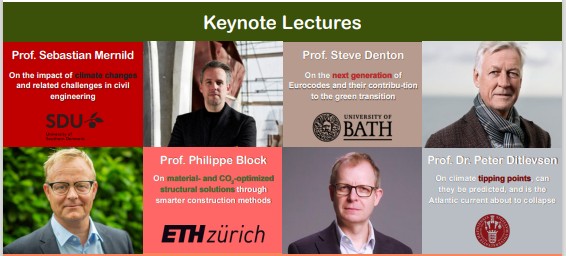
Philippe BlockETH Zürich Read moreTitle: Rethinking Concrete Construction: From research to practice |

|
Steve DentonManaging Director, Civil, WSP Read moreTitle: Evolution of the Structural Eurocodes and their contribution to the green transition All second generation structural Eurocodes will be made available to national standardisation bodies by April 2026, and the first generation Eurocodes will be withdrawn by April 2028 at the latest. The release of the second generation Eurocodes marks the culmination of over a decade of collaborative work by many thousands of experts across Europe. This presentation will provide an overview of the approach taken to develop the second generation Eurocodes, which are expected to be used by over 500 000 engineers, and will highlight some of the key changes. In particular the presentation will set out the steps that have been taken to support the green transition, addressing both carbon reduction and climate change adaptation. |

|
Peter DitlevsenUniversity of Copenhagen Read moreTitle: What are climate tipping points, can they be predicted, and is the Atlantic current about to collapse? The concept of climate tipping points and feedbacks will be explained and the risk of tipping of the AMOC will be presented. The Atlantic meridional overturning circulation (AMOC) is a major tipping element in the climate system and a future collapse would have severe impacts on the climate in the North Atlantic region. In recent years weakening in circulation has been reported, but assessments by the Intergovernmental Panel on Climate Change (IPCC), based on the Climate Model Intercomparison Project (CMIP) model simulations suggest that a full collapse is unlikely within the 21st century. Tipping to an undesired state in the climate is, however, a growing concern with increasing greenhouse gas concentrations. Predictions based on observations rely on detecting early-warning signals, primarily an increase in variance (loss of resilience) and increased autocorrelation (critical slowing down), which have recently been reported for the AMOC. Here we provide statistical significance and data-driven estimators for the time of tipping. We estimate a collapse of the AMOC to occur around mid-century under the current scenario of future emissions.
|

|
Sebastian MernildUniversity of Southern Denmark Read moreTitle: Impact of Climate Change and Challenges The climate is changing rapidly. Temperatures continue to rise, and the pace of change is now significantly faster than ever before. We are already seeing clear consequences in the form of rising sea levels, flooding, and other extreme weather events. The question is what will happen if we continue to emit greenhouse gases at the current rate. What will the world look like in just 75 years – in the year 2100 – and what kind of reality will our children and young people wake up to as they approach their own old age? The decisions we make today will largely determine their future options for action. If current trends continue, we risk crossing critical tipping points, including those related to ice sheet loss and rising sea levels, that cannot be reversed. This is why the need for action is more urgent than ever. |